
How to Learn the 1000 Most Common Japanese Words
If you are learning Japanese, vocabulary is the wall you hit again and again. Grammar you study once and reuse; kanji you can look up. But words? You simply need thousands of them in your head, and there is no shortcut around putting them there. The good news is that a surprisingly small core does most of the work.
Studies of natural language show that the most frequent 1000 words cover a huge share of everyday speech and text. In Japanese, learning this core means that when you watch an anime, read a menu, or have a simple conversation, most of the words flying past you are ones you already recognise. That is the moment learning stops feeling like memorising a dictionary and starts feeling like understanding a language. This guide walks through how to actually get those 1000 words into long-term memory without burning out.
1. Learn in frequency order, not textbook order
Most beginners learn vocabulary in the order their textbook happens to introduce it, which is often grouped by grammar lessons rather than usefulness. If your goal is to understand real Japanese as fast as possible, frequency order is more efficient. Words like する (to do), いる/ある (to be), これ/それ (this/that), and the basic question words appear in almost every sentence. Front-loading them means every sentence you meet afterwards is a little easier.
A frequency-ordered list gives you a clear map: start at the top, work down, and each word you learn is the next most valuable one you could possibly learn.
2. Keep the daily batch small — really small
The single biggest cause of quitting is trying to learn too many words at once. Twenty new words a day sounds modest, but with reviews stacking up it quickly becomes an hour of grinding you start to dread. Dread is what kills consistency, and consistency is the only thing that actually matters over months.
3. Use active recall, not passive reading
Reading a word and its meaning over and over feels like studying, but it builds only weak, passive familiarity — you recognise the word but cannot produce it. What builds strong memory is active recall: seeing the word alone and forcing yourself to retrieve the meaning before checking.
This is exactly why flashcards work so well. The front shows only the Japanese; you have to actually pull the reading and meaning out of your own head; then you flip and confirm. That small moment of effort is what moves a word from short-term to long-term memory.
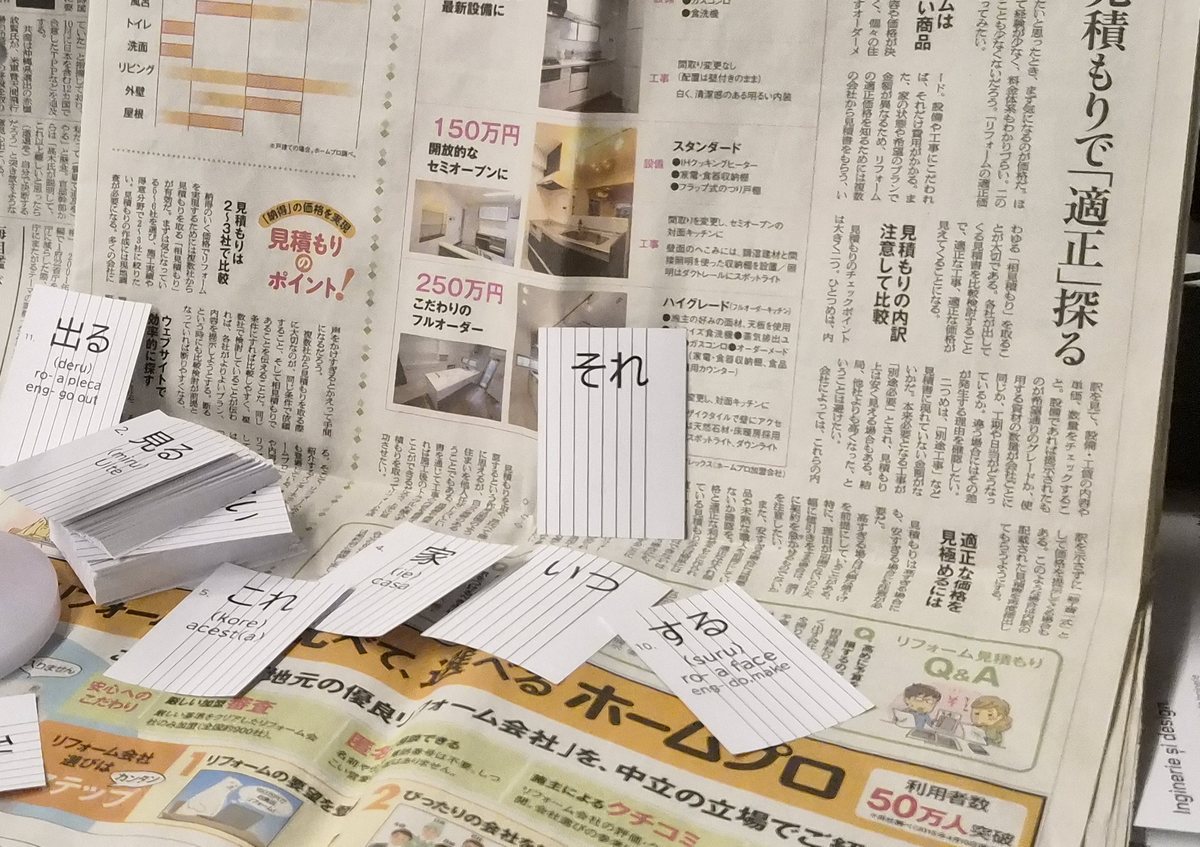
Physical cards vs. apps
Spaced-repetition apps like Anki are excellent and free, and for many learners they are the right answer. But they are not the only answer. Plenty of people — especially those who already stare at a screen all day — find that physical paper cards are what finally makes reviewing stick. No notifications, no algorithm deciding your order; you shuffle by hand, pull your weak cards to the front yourself, and review a small stack anywhere. The best system is simply the one you will actually open every day.
4. Say every word out loud
When you review a card, do not just think the answer — say it. Reading 行く as いく out loud links the sound to the shape far faster than reading it silently, and it trains your mouth for speaking later. It feels slightly silly at first; do it anyway.
5. Understand the front and back of each word
A useful Japanese vocabulary card has more than one layer:
- Kanji — the written form. Recognising it is what lets you read.
- Kana reading — how it is actually pronounced.
- Romaji — the reading in Latin letters, useful while you learn kana.
- Meaning — in your own native language, which sticks better than an English gloss for many learners.
Seeing only the kanji on the front trains reading and recall together; the back confirms both at once. Over time you will no longer need the romaji, then no longer need to flip at all.
6. Review yesterday before you learn today
Memory fades fastest in the first 24 hours. Before adding today's new words, run quickly through yesterday's. It takes two minutes and dramatically improves how much survives. Then do a longer sweep once a week. This rough, manual spaced repetition is enough — you do not need a perfect algorithm, you need to revisit words before you forget them.
7. Accept that slow is normal
Progress with vocabulary is not linear and not fast, and that is completely normal. Some days words will not stick and you will feel like you are going backwards. You are not. Every learner who became fluent went through exactly this. The people who succeed are simply the ones who kept turning over a small stack of cards, most days, for a long time. Lower the daily goal until it is impossible to fail, and let months do the work.
Want to make the cards without the hassle? This site has a free tool that prints all 1000 words as physical flashcards — kanji on the front, reading and translation on the back — in whatever batch size you choose. No signup, no cost.
Open the free flashcard tool →